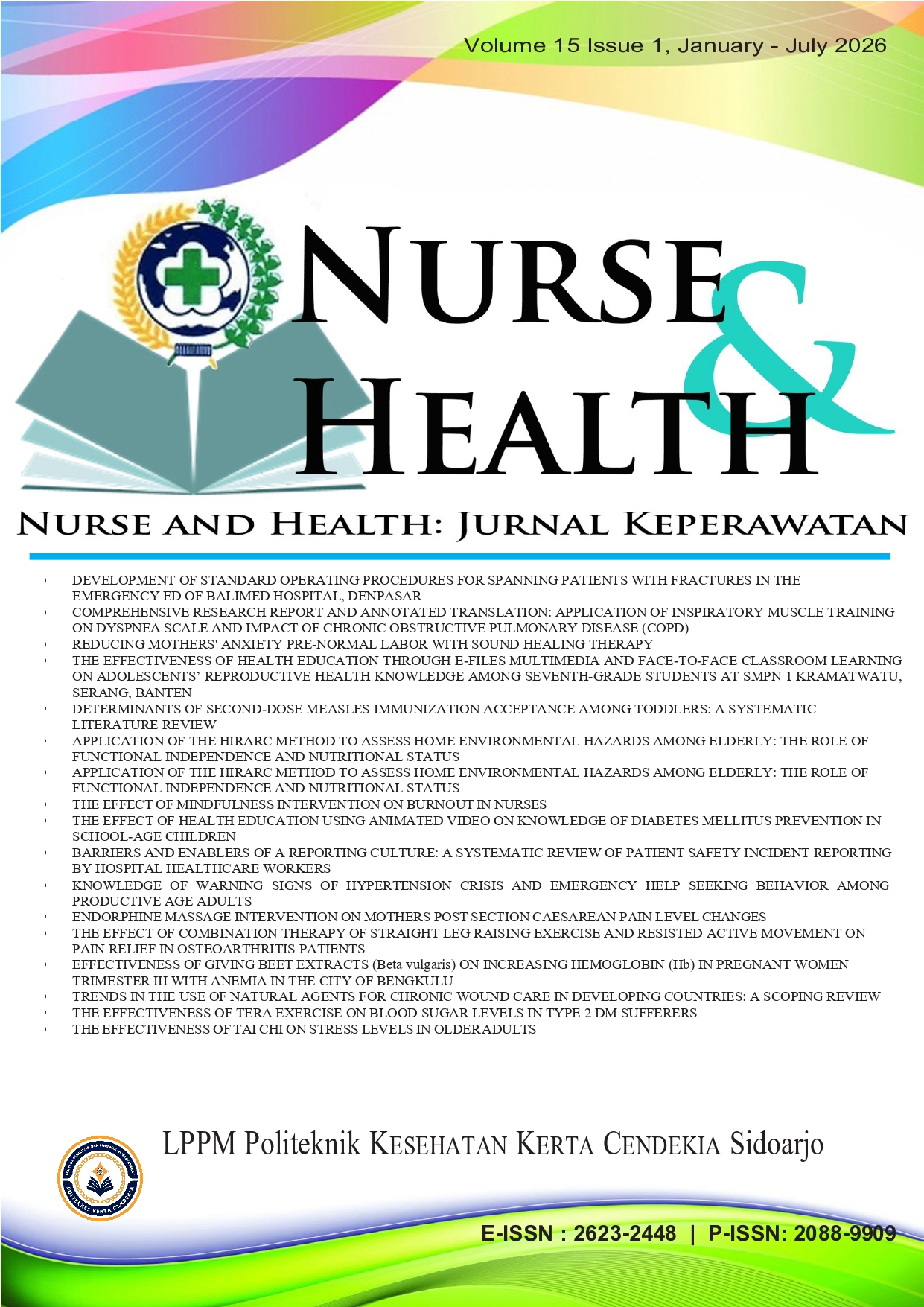
APPLICATION OF THE HIRARC METHOD TO ASSESS HOME ENVIRONMENTAL HAZARDS AMONG ELDERLY: THE ROLE OF FUNCTIONAL INDEPENDENCE AND NUTRITIONAL STATUS
DOI:
https://doi.org/10.36720/nhjk.v15i1.918Keywords:
Elderly, HIRARC, nutrition status, Barthel Index, Nutritional Status, Home Environmental HazardsAbstract
Background: The increasing elderly population is associated with an increased risk of injury due to declining physical function and hazards within the home environment. Home safety is influenced by both environmental and individual factors, including independence level and nutritional status. The Hazard Identification, Risk Assessment, and Risk Control (HIRARC) method can be used to identify and assess home environmental hazards systematically
Purpose: This study aimed to analyze the relationship between independence level and nutritional status with home environmental hazard levels among older adults based on the HIRARC method.
Methods: A cross-sectional analytical study was conducted among 30 alderly selected through total sampling. Independence level was measured using the Barthel Index, nutritional status was assessed using Body Mass Index (BMI), and home environmental hazards were evaluated using the HIRARC method. Data were analyzed using descriptive statistics and Spearman rank correlation tests with a significance level of 0.05.
Results: Most respondents were female (56.7%) and aged 60–69 years (66.7%). Nearly half had normal nutritional status (46.7%) and were categorized as independent (46.7%). Home hazard assessment indicated that 53.3% of homes were at moderate risk. The most common hazards were slippery bathroom floors (60.0%), inadequate lighting (46.7%), and the absence of handrails (40.0%). Significant relationships were found between independence level and home environmental hazards (p=0.004), between nutritional status and home environmental hazards (p=0.028)
Conclusion: Independence level and nutritional status are significantly associated with home environmental hazard levels among elderly. Improving home safety, maintaining functional independence, and promoting optimal nutritional status are important strategies to prevent injuries and support healthy aging
Downloads
References
Adam, C. E., Fitzpatrick, A. L., Leary, C. S., Ilango, S. D., Phelan, E. A., & Semmens, E. O. (2024). The Impact of Falls on Activities of Daily Living in Older Adults: A Retrospective Cohort Analysis. PLOS ONE, 19(1), e0294017. https://doi.org/10.1371/journal.pone.0294017
Badan Pusat Statistik. (2025). Statistik Penduduk Lanjut Usia 2025. Jakarta: BPS.
Cruz-Jentoft, A. J., & Sayer, A. A. (2023). Sarcopenia. The Lancet, 402(10398), 2127–2140. https://doi.org/10.1016/S0140-6736(23)01038-5
Das Gupta, D., Kelekar, U., & Turner, S. C. (2024). Older Adult Falls in the Community: Does Unsafe Home Environment Have a Risk Role Through the Mediating Effect of Functional Limitations. The Gerontologist, 64(5), gnad139. https://doi.org/10.1093/geront/gnad139
Dent, E., Morley, J. E., Cruz-Jentoft, A. J., Woodhouse, L., Rodríguez-Mañas, L., Fried, L. P., & Woo, J. (2021). Physical Frailty: ICFSR International Clinical Practice Guidelines for Identification and Management. The Journal of Nutrition, Health & Aging, 25(7), 824–853.
International Labour Organization. (2022). Fundamental Principles of Occupational Safety and Health. Geneva: ILO.
Kim, G. S., Kim, N., Shim, M. S., Lee, J. J., & Park, M. K. (2023). Understanding the Home Environment as a Factor in Mitigating Fall Risk among Community-Dwelling Frail Older People: A Systematic Review. Health & Social Care in the Community, 2023, 8564397. https://doi.org/10.1155/2023/8564397
Lee, S. (2021). Falls Associated with Indoor and Outdoor Environmental Hazards among Community-Dwelling Older Adults between Men and Women. BMC Geriatrics, 21(547). https://doi.org/10.1186/s12877-021-02499-x
Mackenzie, L., Byles, J., & Higginbotham, N. (2000). Designing the Home Falls and Accidents Screening Tool (HOME FAST): Selecting the items. British Journal of Occupational Therapy, 63(6), 260–269.
Mahoney, F. I., & Barthel, D. W. (1965). Functional Evaluation: The Barthel Index. Maryland State Medical Journal, 14, 61–65.
Mauk, K. L. (2018). Gerontological Nursing: Competencies for Care (4th ed.). Jones & Bartlett Learning.
Rani, I., Zaheer, S., Nasim, S., Shah, N., & Hydrie, M. Z. I. (2025). Assessing Hazards and Associated Fall Risks among Elderly Population: A Cross-Sectional Study of Different Residential Settings in Karachi, Pakistan. BMC Public Health, 25, 850. https://doi.org/10.1186/s12889-025-22016-8
Wang, H., Hai, S., Cao, L., Zhou, J., Liu, P., Dong, B., & Yang, Y. (2022). Association Between Nutritional Status and Functional Ability Among Community-Dwelling Older Adults. BMC Geriatrics, 22, 410.
Wang, Y., Zhang, X., Li, Z., & Chen, L. (2024). Sarcopenia, Nutritional Status and Risk of Falls in Community-Dwelling Older Adults: A Cross-Sectional Study. BMC Geriatrics, 24, 112.
World Health Organization. (2021). Falls Fact Sheet. Geneva: WHO.
World Health Organization. (2021). Malnutrition in Older Persons. Geneva: WHO.
World Health Organization. (2022). Decade of Healthy Ageing 2021–2030: Baseline Report. Geneva: World Health Organization.
Yeung, S. S. Y., Reijnierse, E. M., Pham, V. K., Trappenburg, M. C., Lim, W. K., Meskers, C. G. M., & Maier, A. B. (2023). Malnutrition and Functional Decline in Older Adults: A Systematic Review and Meta-Analysis. Nutrients, 15(3), 612
Ziebart, C., et al. (2021). Development of the Comprehensive Home Fall Hazard Checklist (CHFHC) for Older Adults. International Journal of Environmental Research and Public Health, 18(14), 7423.
Downloads
Published
How to Cite
Issue
Section
Citation Check
License
Copyright (c) 2026 Nurse and Health: Jurnal Keperawatan

This work is licensed under a Creative Commons Attribution-NonCommercial-ShareAlike 4.0 International License.
Authors who publish with Nurse and Health: Jurnal Keperawatan agree to the following terms:
- Authors retain copyright licensed under a Creative Commons Attribution-NonCommercial 4.0 (CC BY-NC 4.0), which allows others to remix, tweak, and build upon the authors' work non-commercially, and although the others' new works must also acknowledge the authors and be non-commercial, they don't have to license their derivative works on the same terms.
- Authors are permitted and encouraged to post their work online (e.g., in institutional repositories or on their website) prior to and during the submission process, as it can lead to productive exchanges, as well as earlier and greater citation of published work (See The Effect of Open Access). Authors can archive pre-print and post-print or publisher's version/PDF.