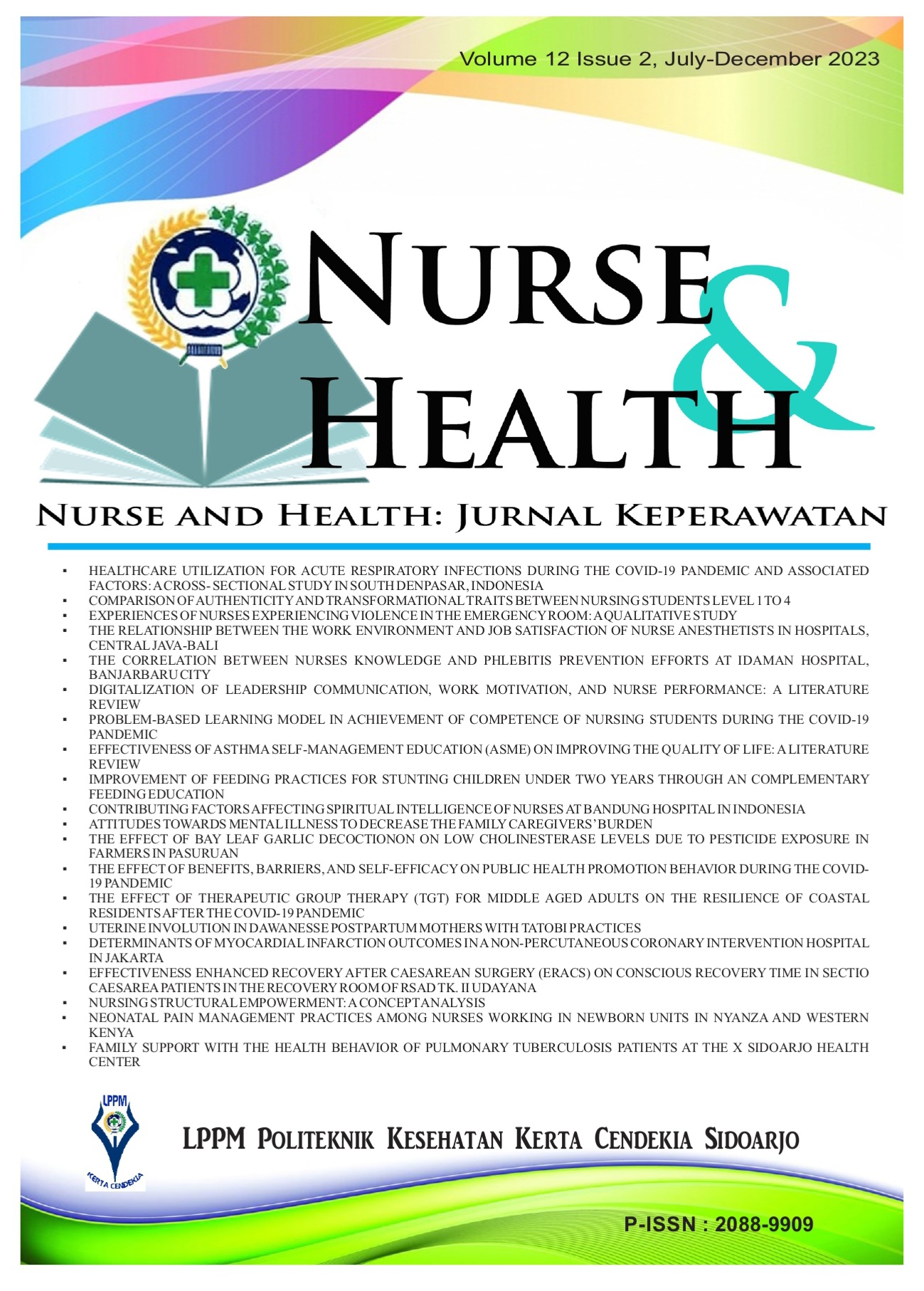
EXPERIENCES OF NURSES EXPERIENCING VIOLENCE IN THE EMERGENCY ROOM: A QUALITATIVE STUDY
DOI:
https://doi.org/10.36720/nhjk.v12i2.527Keywords:
Emergency unit, Experience of nurse, ViolenceAbstract
Background: The phenomenon of violence against nurses is even higher. Still, the results of the study are 80% of nurses who experience violence do not report the incident, nurses take compensatory actions such as sick leave, fear, and lack of support from hospital administration
Objectives: Researchers explored the experience of nurses and the need for more effective protection for emergency unit nurses, this is very important to understand the experiences of nurses who experience violence in the emergency unit.
Methods: The qualitative approach that will be used is transcendent phenomenology (descriptive phenomenology). The population in this study were all emergency unit nurses at the Pontianak City government-owned hospital. Total 15 participants. The criteria for the participants were emergency unit nurses, nurses with experience of acts of violence by others, age > 20 years, and willingness to become participants. The sampling technique used is purposive sampling. Researchers conducted interviews based on the guidelines that had been prepared. The ethical principles were applied on this study. The stages of data analysis in this study are based on the stages of Colaizzi
Results: The results of this study describe the phenomenon of the experience of nurses who experience violence in the Emergency Unit. The five themes include (1) The working period of nurses who experience violence in the Emergency Unit; (2) Causes of nurses experiencing violent behavior in the emergency department; (3) Forms of violent behavior towards nurses in the emergency department; (4) The attitude of nurses who experience violence in the emergency unit; and (5) Protection of nurses in the emergency department
Conclusion: It is believed that nurses who experience violence do not disclose it to management because there is a lack of management support and unclear reporting guidelines. The suggestions are that the management of and prevention of violence against nurses in Indonesia therefore requires management support, documented policies, clear reporting procedures, security systems in hospitals, and clear legal protection by leadership and Indonesian National Nurses Association.
Downloads
References
Afiyanti, Y., & Rachmawati, I. N. (2014). Metodologi Penelitian Kualitatif dalam Riset Keperawatan. Jakarta: Rajawali Pers.
ALBashtawy, M., & Aljezawi, M. (2016). Emergency nurses’ perspective of workplace violence in Jordanian hospitals: A national survey. International Emergency Nursing, 24, 61–65. https://doi.org/10.1016/j.ienj.2015.06.00.
Aljohani, B., Burkholder, J., Tran, Q., Chen, C., Beisenova, K., & Pourman, A. (2021). Workplace Violence in The Emergency Departement: a Systematic Review and Meta-analysis. Public Health , 196, 186-197.
Al-Maskari, S. A., Al-Busaidi, I. S., & Al-Maskari, M. A. (2020). Workplace violence against emergency department nurses in n Oman: a cross-sectional multi-institutional study. International Nursing Review , 1-9.
Boyle, M. J., & Wallis, J. (2016). Working towards a definition for workplace violence actions in the health sector. Safety in Health, 2(1), 2–7. https://doi.org/10.1186/s40886-016-0015-8
Beck, C. T., & Polit, D. (2012). Nursing research generating and assessing evidence for nursing practice (Ninth ed.). Philadelphia: Lippincott Williams & Wilkins.
Chapman, R., Perry, L., Styles, I., & Combs, S. (2013). Predicting patients violence againts nurses in all hospital areas. British Journal of Nursing , 18, 476-483.
Christlevica, M., Aileen Joan, G., & Ricky, D. (2016). Experience Of Violence Againts Nurses In Emergency Departement. Jurnal Skolastik Keperawatan, 2(1), 20–35.
Creswell, J.W. (2013). Qualitative inquiry and research design choosing among (6th ed.) Thousand Oaks: Sage
Davey, K., Ravishankar, V., Mehta, N., Ahluwalia, T., Blanchard, J., Smith, J., et al. (2020). A Qualitative Study of Workplace Violence Among Healthcare Providers in Emergency Departements in India. International Journal of Emergency Medicine , 33 (13), 1-9.
Fadhillah, H. (2021). Ada 8 Kasus Kekerasan ke Perawat di 2020-2021, Pelakunya Sipil hingga Pejabat. (L. N. Arunanta, Ed.) Jakarta, DKI Jakarta, Indonesia: detikNews. Retrieved Mei 3, 2021, from https://news.detik.com/berita/d-5535953/ada-8-kasus-kekerasan-ke-perawat-di-2020-2021-pelakunya-sipil-hingga-pejabat
Hogarth, K., Beattie, J., & Morphet, J. (2015). Nurses' attitudes towards the reporting of violence in the emergency department. Australasian Emergency Nursing Journal , 19, 75-81.
Kelley, E. (2014). Reducing violence in the emergency departement: A rapid response team approach. Journal of emergency nursing , 1, 60-64.
Lee, H.-L., Han, C.-Y., Lin, C.-C., & Chang, W. (2019). Workplace Violence Against Emergency Nurses in Taiwan: A Cross-Sectional Study. Journal Of Emergency Nursing , 1-6.
Lenaghan, P., Cirrincione, N., Henrich, S., & NE, O. (2017). Preventing Emergency Department Violence Through Design. Journal of Emergency Nursing , 1-6.
Mento, C., Silvestri, M. C., Bruno, A., Muscatello, M. R. A., Cedro, C., Pandolfo, G., & Zoccali, R. A. (2020). Workplace violence against healthcare professionals: A systematic review. Aggression and Violent Behavior, 51(April 2019), 101381. https://doi.org/10.1016/j.avb.2020.101381
Noorana Zahra, A., & Feng, J. Y. (2018). Workplace violence against nurses in Indonesian emergency departments. Enfermeria (Noorana & Feng, 2018) Clinica, 28, 184–190. https://doi.org/10.1016/S1130-8621(18)30064-0
Sharifi, S., Shahoei, R., Nouri, B., Almvik, R., & Valiee, S. (2019). Effect of Education Program, Risk Assessment Checklist and Prevention Protocol on Violence Against Emergency Departement Nurses: A Single Center Before and After Study. International Emergency Nursing , 1-6.
Song, C., Wang, G., & Wu, H. (2021). Frequency and barriers of reporting workplace violence in nurses: An Online Survey in China. International Journal of Nursing Sciences , 8 (1), 65-70.
Pich, j., Hazelton, M., Sundin, D., & Kable, A. (2011). patient-related violence at triage ; a qualitatative descriptive study. International Emergency Nursing , 19, 12-19.
Vogel, L. (2016). Abusive patients: It is time for accountability? Canadian Medical Association Journal , 11, 241-242.
Zhang, L., Wang, A., Xie, X., Zhou, Y., Li, J., Yang, L., & Zhang, J. (2017). Workplace violence against nurses: A cross-sectional study. International Journal of Nursing Studies, 72(April), 8–14. https://doi.org/10.1016/j.ijnurstu.2017.04.002
Downloads
Published
How to Cite
Issue
Section
Citation Check
License
Authors who publish with Nurse and Health: Jurnal Keperawatan agree to the following terms:
- Authors retain copyright licensed under a Creative Commons Attribution-NonCommercial 4.0 (CC BY-NC 4.0), which allows others to remix, tweak, and build upon the authors' work non-commercially, and although the others' new works must also acknowledge the authors and be non-commercial, they don't have to license their derivative works on the same terms.
- Authors are permitted and encouraged to post their work online (e.g., in institutional repositories or on their website) prior to and during the submission process, as it can lead to productive exchanges, as well as earlier and greater citation of published work (See The Effect of Open Access). Authors can archive pre-print and post-print or publisher's version/PDF.